MetalsMetals as canvas are used exclusively in the oil technique. They are more durable than, for example, wood and canvas, but they too have various disadvantages:
- Under the influence of temperature (heat and cold), metals enlarge their volume or shrink more than the gesso and paint layer. This leads to the formation of cracks and the settling of the gesso and paint layer.
- The surface of metals binds poorly with oil gesso and with oil pigments.
Metals do not need to be primed, as long as their color suits our needs. It is enough only to give them the right roughness (mechanically or chemically).
When working on metals, the correct layering of paints should be carefully observed. The main thing is that the lowest layers should not contain unnecessary oil and should be well dried before applying further layers. Otherwise, dangerous cracks will form in the entire paint layer.
Each metal has its own properties:
ZincMore than other metals, it expands and contracts under temperature changes.
Paint holds on it less well than on other metals.
Lead and copper dyes in contact with zinc quickly blacken and fall off its surface.
Stereochromes paint best on zinc substrates.
CopperStrongly oxidizes turning blue, which can affect the painting layer.
In the 18th century, it was common to paint on copper and most paintings have survived well.
LeadOxidizes with difficulty and is therefore suitable for painting. It was used as early as the 17th century.
Because of its softness, a wood or iron primer was added.
Aluminum
In air, it is covered with a colorless oxide that does not affect the paint layer.
The paint layer adheres well to the aluminum surface even during temperature fluctuations.
WoodWood is used as canvas in the form of whole boards or glued together from pieces.
For canvas can be used:
- oak,
- poplar,
- chestnut,
- pine,
- cedar,
- maple,
- pear,
- birch,
- linden.
In northern Europe, oak was most commonly used. In the east, alder, birch and linden.
The wood tends to "work" under the influence of temperature changes, so it should be properly prepared.
According to the old Dutch way, it is best to boil the dry and sanded board in water with garlic. Then dry at 50°C so that the water evaporates thoroughly.
In this way, soluble and proteinaceous components were removed from the wood, which were cut down in the hot water.
After drying, the board is saturated with a disinfectant solution, sanded and primed.
It is best to prime both sides of the board at once reducing the work of the wood.
If the wood is tarred, the board should be coated with a solution of shellac in spirit or fiber in acetone before priming.
It is also a good idea to stick a canvas on the board - it protects the painting layer from cracking.
Before sticking the canvas, the board should be disinfected.
A board specially prepared by a carpenter (glued together from pieces) does not need to be primed on both sides, as the force of glue and water will not be able to warp it.
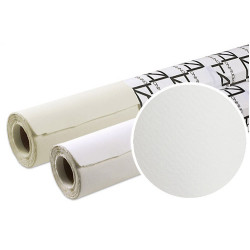
CanvasCanvas is the cheapest and most convenient sub-image.
In the past, canvas was used only for decorative purposes. Since the 16th century, with the oil technique, it came into widespread use.
Disadvantages:
- it tears easily;
- it shrinks and expands from humidity fluctuations, with different thread tension in the warp and weft;
- the back of the canvas is easily affected by microorganisms and moisture.
Linen or cotton canvas is best for painting.
The threads of the weft and warp must be of equal thickness, without knots.
Before priming, wash off the aprette
- Canvas operations:
- Stretching the canvas on the stretcher bar.
- Stitching.
- Pasting.
Pasting should always be used, regardless of the type of gesso and canvas used.
A 5% solution of glue or gelatin is used for re-sticking.
Tight canvas is resealed with lukewarm glue. Rare canvas can be reglued with cold and jelly glue, rubbing it in with a brush.
The glue is spread thinly and evenly. Excess is collected with a knife.
After pasting, the canvas dries for 12 hours. Then it is sanded to make it rough and primed.
Pasting is started from a weaker to a stronger solution.