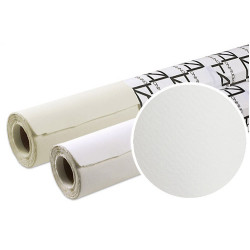
Glue primerPure glue gesso is more likely to be used on wooden canvas, as it is not flexible on canvas.
When preparing the glue gesso, the proportions must be strictly observed, which affects its absorbency.
The glue primer must be flexible, have an even layer thickness and enough of its own binder so that it does not absorb the binder from the paints.
SandingExcept for the last one, each layer must be sanded and applied only after the previous layer has dried.
The gesso must be thin enough to let the canvas grains shine through.
Advantages of adhesive mortars- Oil paints blend better with them.
- Oil paints dry better on them (especially in the lower layers, which protects the paint layer from cracking).
- They are quick to make and use.
Glue mortar laid on a board is the "Dutch way" of preparing a canvas.
The adhesive mortar laid on the canvas should be flexible.
The flexibility of the mortar depends on the type of glue used.
It is best to use fish glue.
Emulsion gesso primerIntermediate between adhesive and oil and also the best for oil painting.
It is resistant to moisture and flexible. It dries after two days. Gives good adhesion for oil paintings by partial absorption.
It must be applied in several layers. In the top layers, the amount of oil is increased and the amount of glue is decreased.
It consists of a different set of emulsions: glue and oils or resins.... or on egg.
Composition of the gessoA fairly thick solution of glue with the addition of oil forms an emulsion.
Then zinc white and chalk mixed with water are added.
Before priming, the canvas is recrossed.
Glue-emulsion gesso primerComposition for 2 m2 of canvas:
- 20 g of carpenter's glue,
- 100 g of water,
- 100 cm3 oil,
- 110 g of zinc white,
- 35 g of chalk.
Oil can be added only after mixing all the ingredients.
Water is added as needed.
If there is no zinc white powder, you can use white from a tube for the glue-emulsion gesso.
Gelatin-emulsion gesso primerIngredients:
- 20 g gelatin,
- 100 cm3 zinc white,
- 70 cm3 linseed oil,
- 100 cm3 water.
Wanting to improve a failed emulsion, add a little soap or ammonia.
Egg-oil gessoComposition:
- 60 cm3 of water;
- 1 egg (rubbed through a sieve with a brush);
- 20 cm3 of boiled or ordinary oil;
- 30 g of zinc white.
Add some varnish to the egg - gradually, stirring constantly, and dilute the white with water and, adding it to the emulsion, stir constantly.
Improving the glue gessoWanting to make the glue gesso free of excessive absorbency, it should be covered with a gelatin solution (4 ÷ 5%) after drying, and then with a 4% formalin solution.
The glue primers developed in this way have the properties of oil gesso, but without its deficiencies.
Oil-based gesso Oil gesso primers are not suitable for the oil technique because they are not absorbent.
If you want to paint on oil gesso, you need to soften it by saturating it with toluene, benzene or turpentine.
The canvas is repainted before priming, and then covered twice with oil painting with lead white for flexibility.