ARTISTS' OIL PAINTS ARTISTS' OIL COLORS
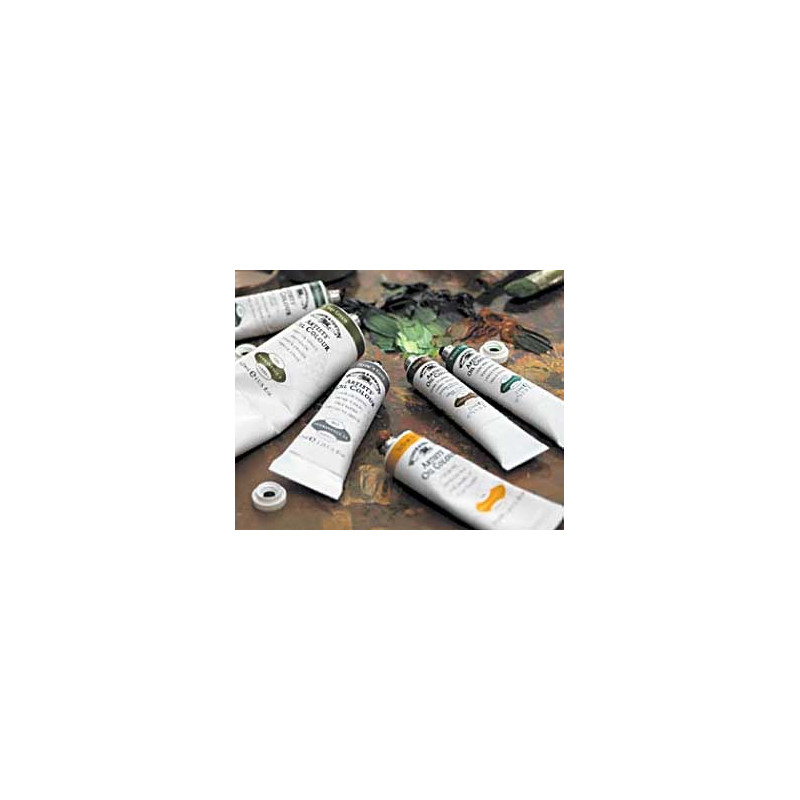
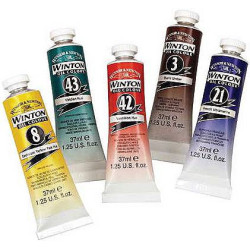
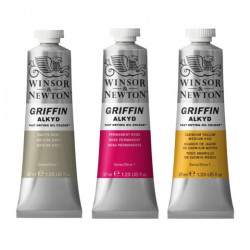
The oil paints in the Artists' Oil Colors range are grated according to the most detailed and precise production specifications, using the best pigments and binders available. The result is a product that strives to meet the expectations of artists and their assumptions of working with the finest possible material. The Artists' Oil Colours range of oil paints offers a balanced spectrum of 114 colors available in 37 ml tubes (with the exception of lead white).
Spectrum of colors
The Artists' Oil Colour range has the widest spectrum of colors to offer of any of Winsor&Newton's oil painting ranges available Individual colors are selected according to dominant tonality (color obtained straight from the tube), undertone (color tone obtained when a thin layer of paint is applied), tinting strength and degree of transparency.
Composition
Each of the paints available in the Winsor&Newton Artists' Oil Colour range is composed individually, taking into account the natural properties of the individual pigments, with the goal of bringing out their best qualities and ensuring that the paint is as stable as possible.
Pigment content/coloring strength.
The creation of paints from the Artists' Oil Colour range is carried out with the assumption of the highest degree of pigmentation, combined with the most versatile possibilities for the use of working with this material. The strength of the pigment affects the paint's hiding and coloring power, ensuring that each paint will be used to the greatest advantage for the artist.
Quick-drying paints [about two days]:
Cobalt yellow (aureolin), dark purple /Permanent Mauve/ [manganese], cobalt blues, Prussian blue, natural sienna, umber, whites - Flake, Foundation and Cremnitz Whites [lead].
Paints characterized by medium drying time [about five days]:
blues and greensWinsor [phthylcyanines], burnt sienna, cobalt purples and greens, blues
ultramarine, mars colors [synthetic iron oxides], permanent succulent green, permanent alizarin crimson /Permanent Alizarin Crimson/, ochres, cadmiums, titanium white, zinc white, ivory black and soot black.
Slow-drying paints [over five days]:
Winsor yellows and oranges [aryl compounds], quinacridone pigment-based paints, alizarin crimson /Alizarin Crimson/. As with all oil works, in order to avoid yellowing of the oil, the paint job should not be left to dry in a constantly darkened room or in a place of high humidity.
White paints.
The eight whites available in the Artists' Oil Colour range provide the artist with the widest possible selection. The same is true of every other part of the color spectrum. Because of their brightness and less tendency to yellow, most whites are created when combined with safflower oil.
Safflower oil-based whites
Titanium White /Titanium White/: is the most popular contemporary white. It has the greatest depth of white; of all, it is the most opaque. It is softer than Flake White No. 1.
Flake White No. 1 /Lead White no. 1/: The traditional lead white in the oil painting range, Flake White is an excellent painting material because of its versatility, brushability, durability and drying time. The presence of zinc pigments benefits the consistency of this paint. At the same time, it is the most rigid white in the range.
Flake White No. 2 (Lead White No. 2): A variation of Flake White No. 1, characterized by a smoother consistency.
Zinc White /Zinc White/: is the most transparent of all whites, making it ideal for underpainting and glazing. It also has the rarest consistency.
Cremnitz White/Lead White/: also made with a lead base. The lack of zinc in its composition gives it a somewhat fibrous consistency. Some artists prefer pure lead colors as a rule.
Iridescent White /Iridescent White/: Formulated with mica pigment, this paint results in a pearlescent white. Using it gives good results when combined with transparent colors.
A few words on the use of whites for underpainting and priming: saffron whites are not recommended for large areas of underpainting, nor as a gesso. When oil painting dries, its layers undergo various spatial changes, decreasing, or increasing in weight, which involves the occurrence of various chemical reactions. Semi-drying oils such as safflower oil and poppy seed oil undergo more changes than linseed oil. While the white created from safflower oil is excellent for use in normal paint applications and blending, it is not suitable for underpainting. The movement of the paint film can lead to cracking of the layers applied above. Therefore, the following linseed oil-based whites are recommended for primers and underpainting:
Underpainting White /white used for underpainting/: Titanium pigment in
combined with linseed oil results in a paint that is recommended for underpainting and for painting extensive surfaces with a layer of white.
Foundation White: is a lead pigment combined with linseed oil, recommended for underpainting and extensive layers of white when using lead white. Both Underpainting White and Foundation White can be used throughout the painting job, if that is the intention of the artist.