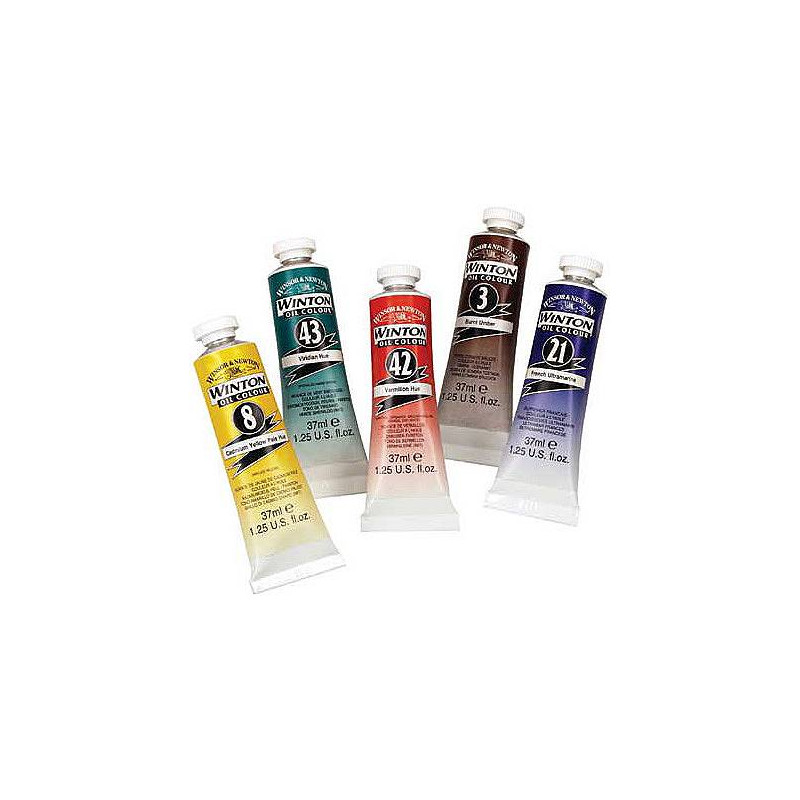
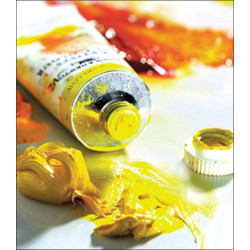
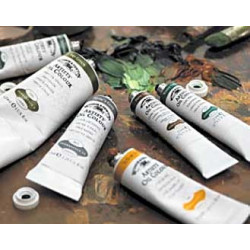
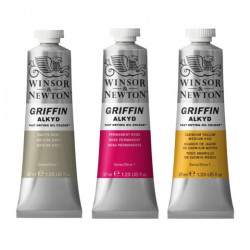
Winton is a traditional range of paints made from pigments at a medium price level, composed with amateur artists in mind, as well as more experienced painters who, using large quantities of paints, are interested in a not-too-exorbitant price.
Color spectrum
The Winton range of products has been composed of pigments, offering the widest possible palette of colors at a reasonable price. The spectrum has been composed to provide the greatest variety and combinability of individual colors in the palette. In addition, the color spectrum of the Winton range has been composed in such a way that references to the Artists' Oil Colour range can easily be found in it, while ensuring the purity of combining individual paints and at the same time helping artists transition to the higher-grade Artists' Oil range in a timely manner.
Composition
As with the Winsor&Newton Artists' Oil Colour range, each of the paints available in the Winton range has been composed individually, taking into account the natural properties of the individual pigments, with the goal of bringing out their best qualities and ensuring the greatest possible color stability.
Pigment content/pigment strength
The high level of pigmentation ensures good covering power and tinting strength. While the Winton range can't quite match the excellent level of pigment content represented by the Artists' Oil Colour range, it is much stronger than many other art paint ranges. The unaffordable cost of the Winton range has been achieved by using pigments at the mid-price level, rather than by reducing the pigment content to a level that is difficult for the artist to accept. The composition, manufacture and quality control of Winsor&Newton paints ensure the highest quality products in each available range.
Viscosity/consistency
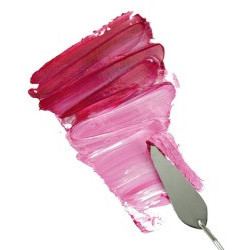
The Winton range of paints has a more homogeneous consistency than the Artists' range, and as a result we are dealing with more 'stiff' products. It offers artists excellent retained brush strokes and spatula marks.
Coating sheen
As with the Artists' Oil Colour range, the sheen of the Winton paints' coatings is largely related to the use of pigments. As such, the level of gloss will vary depending on the pigment used.
Durability
In every possible case, pigments as durable as possible have been selected for use in the Winton product range. The way Winsor&Newton composes and manufactures its paints ensures that each product will remain stable in the tube, as well as offer the most durable color coating possible (assuming proper application). Wanting to be sure of the durability of individual paints, check the durability labeling in the color chart, or on the tube.
Drying time
Drying time for all oil paints ranges from 2 to 12 days. The different drying time depends on the different reactions of each pigment when binding to the oil. In practice, each Winsor&Newton paint is composed individually taking into account the properties of the pigments in order to optimize drying time, thus trying to help painters avoid problems with slow drying of the bottom layers.
However, the following list provides an indication of likely dryingtime differences:
Quick-drying paints [about two days]: Prussian blue, natural sienna, umber,
Flake White [lead white].
Paints with an intermediate drying time [about five days]: blue
Phthalate and Emerald Green /Viridian Hue/ [phthalocyanines], burnt sienna, ultramarine blues, synthetic lead oxides, ochres, titanium white, zinc white, soot black, ivory black.
Slow-drying paints [more than five days]: cadmium shades [aryl compounds], Permanent Rose [quinine compounds], alizarin crimson shade /Alizarin Crimson Hue/.
White paints. White is the most widely used paint. The four whites available in the Winton Oil Colour range have slightly different properties:
Titanium White /Titanium White/: the most popular and most widely used contemporary white. It is characterized by the greatest depth of white and, of all, is the
the most opaque.
Flake White /Lead White/:the traditional lead white in oil painting kits. Flake White works well as a painting material because of its
flexibility and versatility, durability and speed of drying. The presence of zinc pigments benefits its consistency.
Zinc White /Zinc White/: the least opaque of all whites. This property makes it ideal for tinting and glazing.
Soft Mixing White: a titanium-based white characterized by the most
soft consistency. It has less covering power than titanium white.
Winton whites are created on the basis of safflower oil, which makes them produce the whitest shades of white. These paints are not recommended for use in underpainting and gesso. The rather slow drying of this type of oil means that these whites can cause cracking of the paint layers above. Underpainting White and Foundation White from the Artists' Oil Colour range are recommended for underpainting, as well as intensive modeling with whites.