A word on pigment strength.
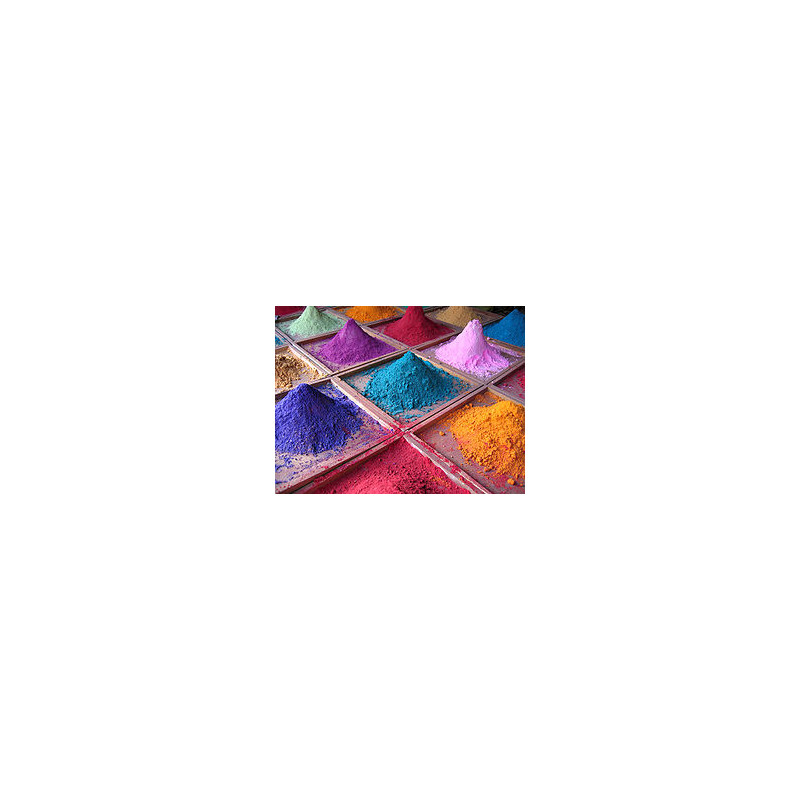
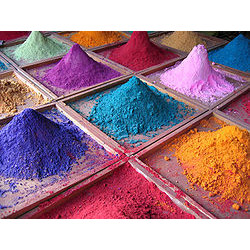
There is a fairly common, albeit erroneous, belief that pigment strength is the sole determinant of good paint. Such thinking is fraught with oversimplification. A high ratio of pigment coloring strength is an important thing, but too much pigment can make working with paint difficult, or even impossible.
For example, filling a tube with too much phthalocyanine pigment would result in a paint with too much coloring strength, dominating and drowning out any other colors with which it would be combined. On the other hand, some pigments by their nature are quite weak when it comes to coloring power. Composing, for example, the color green - 'earthy green' /Terre Verte/, involves using a large accumulation of pigment (or its concentration in the tube). Due to the physical structure of this pigment, Terre Verte paint is quite weak in terms of coloring power. Paints, lauded by manufacturers as consisting of only 'just the
pigment and oil', in practice can be a relatively difficult painting material: stiff, sticky, lacking in luminosity and often unstable. Each of these characteristics individually and all together make it more difficult for an artist to create a solid paint film on a substrate.
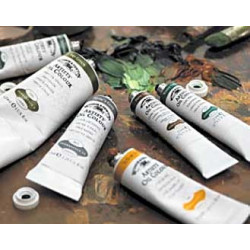
Although Winsor&Newton /Artists' Oil Colour/ Artistic Oil Paints essentially belong to a group of paints that can be said to consist of 'pigment and oil' alone, their quality, stability and durability are determined not only by factors such as the type and quality of each of these components, but also by the way they are combined, the appropriate use of auxiliary substances, the equipment used to mix the ingredients, and the many years of experience of those working on the excellence of the final product. In the case of Winsor&Newton's products, all of the above-mentioned factors are in proper balance - including the balance of pigment strength necessary to obtain a painting material of the highest level, giving the artist freedom and control over that material. When all variables are taken into account, Winsor&Newton paints generally exhibit the highest possible pigment strength.
Paints with homogeneous pigment.
The overriding principle in composing Winsor&Newton paints is to use homogeneous pigments whenever possible. The quality of paints produced with a single pigment is much better than those made with multiple pigments, or several combined. The covering power of paint is not the only advantage of using a single pigment, it is also associated with a range of products that offer cleaner, brighter color combinations and a huge range of shades. This is particularly important for colors such as greens, oranges and purples. The use of homogeneous pigments in the formulation of such auxiliary colors tremendously increases the color spectrum available to the artist. 95 different types of pigments are used to produce a palette of 114
paints from the Artistic Oil Paint range.
Replacement colors - shades.
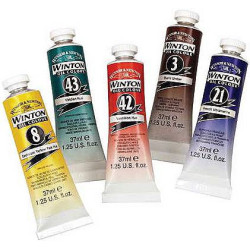
The biggest contributor to the price of high-quality art paints is the cost of pigment. For example, cadmiums, cobalts, or blues of the genus ceruleum (sky blue) are among the paints that are expensive to produce. Many artists, attached to the high quality of such pigments, will not be deterred even by the high price. However, for painters, expecting from paints above all cleanliness and ease of blending, a wide but not necessarily full spectrum of colors, as well as decent quality, a range of studio paints (such as Winton oil paints) may prove to be the best solution.
Hue paints have been composed using alternative pigments, with an eye toward getting closer to the original primary color, at a lower cost for such a paint. Because each pigment is unique, Hue paints behave differently from their original counterparts, offering properties that may be preferred by some artists for specific applications.
Winsor&Newton's studio range includes paints referred to as hues. For example, we have shades of cadmium red, ceruleum - sky blue and cobalt blue. These are paints that use alternative pigments in their formulation, with the aim of getting closer to the original base color, at a lower cost for such a product. However, the real difference is based on working with such material and its properties. Comparing, for example, cadmium red with its equivalent shade of this color (hue), it is easy to see at first glance that both are bright red. Both are also very durable, but the difference is that the cadmium base color is opaque, while its hue is transparent. The paint in the 'shade' range should not be classified as a lower quality material. Due to its natural transparency and blending characteristics, many artists may prefer paints in the shade range. In the range of artist paints, the word hue - Hue, is used, thus indicating at which color an alternative pigment was used in place of the original one, which, for some reason, is no longer available.
Transparency vs. opacity properties.
The physical structure of the pigment determines whether the paint will be opaque, semi-opaque or transparent. For example, when viewed through a microscope, the pigment - pure phthalocyanine - appears translucent, as is the case with stained glass. This feature makes paint based on this pigment suitable for
use in glaze and for creating pure color combinations. The opposite is true of cadmium pigment, which is inherently dense, compact and opaque, which consequently allows it to transmit a minimal amount of light, or block it completely. Naturally, opaque paints are best suited for applications requiring maximum covering power of the painting material. By gaining experience, a painter can learn to take full advantage of the paint material's natural covering properties, or its transparency. He uses these properties to achieve an almost unlimited number of shades, as well as the purest, brightest possible paint combinations.