Lead gives a whole row of dyes of white, yellow and red color, consisting of various lead oxides and lead salts, such as chromium, chlorine, cypra.
The lead present in the dye, in one form or another, gives it its peculiar character.
Properties:
1. fairly high specific gravity.
2. high covering power.
3. Greater or lesser poisonous properties.
4. Sensitivity to sulfur compounds (blackens - PbSi).
5. dries well in oil and accelerates the drying of other dyes mixed with it.
Lead white (Kremserweiss)
Known in deep antiquity.
It is mentioned in their treatises by Vitruvius and Pliny.
In the Middle Ages it was produced by the Venetians. Later, the production of this white was made famous by the Hungarian city of Kremnitz (the name of one of the better grades of lead white was derived from the name of this city) and the city of Krems in Austria, from which the most popular name of this white - Krems - takes its origin.
Chemically, it is an alkaline lead carbonate.
The covering power of lead white is based on the content of lead hydroxide Pb(OH)2. Lead carbonate 2PbCO3 is poorly opaque. If the lead white is exposed to moisture and charcoal from the air, the lead hydroxide transforms into lead carbonate, which causes the lead white to show through.
Lead white is characterized by its elasticity and therefore even thicker layers are not subject to cracking over time.
This elasticity is given by so-called "lead soaps" formed from combinations of fat (oil) with an alkali group included in lead white.
A chemical compound called linoleate is formed. Linoleates do not hydrolyze and hence lead white's resistance to moisture.
During roasting, lead white turns pink. This is explained by its transformation into lead oxide - minia.
Lead white accelerates the drying process of oil or paints associated with it (acts as a siccative). Strongly poisonous, it causes a disease called "leadosis."
Resistant to light and weathering. Used in all techniques except wall and stereochrome. Sensitive to alkali. The amount of oil needed for rubbing varies from 8 to 14%.
There are four ways to produce lead white:
1. Venetian or Dutch:
Spiral-rolled lead leaves were placed in an earthenware pot and acetic acid was poured into the bottom of the pot. The pot was covered with some sort of material containing putrefactive substances and emitting heat. Under the influence of heat, the acetic acid evaporated and reacted with the lead, producing, with the help of oxygen in the air, an acetic-lead salt.
The resulting salt, under the action of CO2 emitted from the putrefactive substances lining the vessel, turned into alkaline lead carbonate.
2 German method of obtaining lead white:
Lead leaves were placed in a wooden chamber, through the floor of which the fumes of acetic acid, water and CO2 obtained by burning wood or charcoal were emitted. An identical chemical process occurred as in the Venetian method.
The white obtained by these methods was rinsed with water to purify it of the so-called "lead sugar." It was then blended with water, dried and pulverized.
3 English way:
Lead glycine was mixed with lead sugar and treated with CO2.
4 French way:
A solution of lead sugar was acted on with CO2 or soda. A very pure but poorly opaque product was obtained.
More recently, lead white is obtained by electrolysis.
Recognition:
Roasted - it acquires an orangish shade, after cooling turning to light yellow. It dissolves in dilute nitric or acetic acid, at ordinary temperature giving a colorless, transparent solution without a precipitate.
The precipitate is a sign of admixtures.
Minia
A dye with a bright red-orange hue, known since ancient times. Chemically - lead oxide (with a higher degree of oxidation than ordinary lead oxide). A better grade of minia was obtained by roasting lead white.
It needs 10 to 15% oil, and dries quickly. When combined with vegetable dyes, it discolors them while discoloring itself.
It also loses its color when mixed with lead white and under exposure to light.
It is resistant to alkali and thus can be used in fresco and stereochrome techniques.
Recognition:
Concentrated acetic acid dissolves the mine completely, forming an acetic-lead salt.
Palettes
Non-cracking, hard wood, saturated with varnish or resin.
Brushes
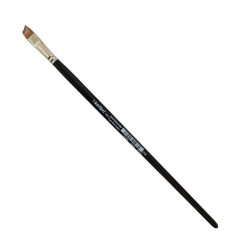
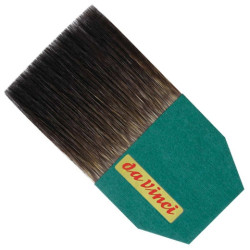
Stettinous: flat or round. Soft ones: badger, squirrel.
Washing brushes: water and soap, gasoline, turpentine.
Storage of brushes: suspended in non-drying oil.