By mechanically mixing fat - in this case oil - with water, we will get a cloudy liquid (a suspension of oil particles in water), which will very quickly disintegrate into oil and water.
When a substance that is soluble in water and gives it viscosity (such as glue) is added to the water, the mechanically mixed particles will not disintegrate.
An emulsion is called a mechanical mixing of water-soluble substances with water-insoluble substances.
Emulsions are divided into natural and artificial.
Natural ones are:
- milk,
- egg,
- juices of various plants.
Some of them, such as egg yolk, are characterized by high durability.
Artificial emulsions can be of two types:
- Oil in water:The external phase of such an emulsion is water, and water provides the dilution of this emulsion. The density of such an emulsion depends on the concentration of the internal phase (oil) and on the degree of fineness (dispersion), which can be adjusted.
- Water in oil:The outer phase of this emulsion is oil or resin. This type of emulsion is not soluble in water.
The type of emulsion depends on the emulsifier and its concentration.
Water-wetting emulsifiers give a type one emulsion.
Emulsifiers wetting in oil give emulsion type two.
In general, the one of the emulsion components forms the outer phase in which the emulsifier dissolves more easily. For example, soaps that are well soluble in water give emulsion type one.
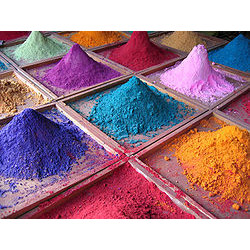
For emulsions that are not diluted with water (type two), hydrophobic dyes (which thicken the water-in-oil emulsion on their surface) such as soot or mica are suitable.
Hydrophilic pigments - which thicken oil molecules in water - are suitable for emulsions of type one (diluted with water). These include such pigments as ochre, ultramarine or yellow cadmium.
As emulsifiers are found in tempera:
- glue,
- casein,
- egg white and egg yolk,
- gum arabic,
- tragant,
- flour glue (clarifier),
- soap (soap has a high emulsifying power and can serve as an addition to weaker emulsifiers, such as gum arabic, tragant).
Ammonia and other casein solvents are also helpful in emulsion formation.
Strong alkalis emulsify very vigorously, but should be avoided because of dyes that are sensitive to combinations with them.
Oil emulsifies more easily than varnish. Oxidized oils (i.e., thickened in air) have a high tendency to form emulsions even with water alone.
When preparing an emulsion, follow the proportions exactly and use a reasonably strong emulsifier. Otherwise, the emulsion will quickly decompose.
Decomposition of weaker emulsions (such as gum Arabic) is favored by heat and the addition of spirit.
Stronger emulsions are resistant to heat, but decompose from spirit.
An emulsion with oil is more flexible than a pure egg emulsion and lends itself to thicker layering.
In the dried artificial emulsion, the oil molecules are in the fragmentation and do not undergo the same process as in the pure oil technique. They serve only as tempera fixatives.