A very limited palette is used for fresco. The fewer pigments, the easier it is to deal with the problems of drying different colors.
Drawing is transferred by sprinkling and imprinting on plaster.
When painting, you can achieve effects similar to watercolor, using the whiteness of the plaster. Therefore, it is good to add crushed marble to the intonaco instead of sand.
In general, the fresco technique is eminently laser-like, in that it resembles watercolor.
Individual parts of the painting must dry slightly after applying the paint (the water should enter the plaster) - only then can you paint a second time.
Working with this technique, it is necessary to cover the individual parts of the painting with water at the same time, because the places bypassed for a long time dry and the paint does not fix on the surface of the plaster.
The only binder in the fresco is calcium carbonate made from calcium hydroxide in combination with air. Therefore, areas that are not painted for the time being need to be wetted with clean water from time to time to prevent the plaster from drying out and forming a layer of calcium carbonate.
Unless the laid intonaco is painted during the day, it should be removed, and the ends of the painted plaster should be moistened quite strongly with clean water.
In the event that a section of the painting is not to the painter's liking, that section can be cut out and a new intonaco put on to paint over it anew.
There is also a second way of fresco technique, in which, instead of lime water, lime cake is added to each dye, which serves both as a binder and as a whitewash.
In this case, it is much easier to paint, since it is an opaque technique and the paints can be layered.
Too much layering is not advisable due to the lower durability of such a painting.
This way of painting is visually different from the first way, because here lime white is added to each pigment (even dark) and the whole thing has a character similar to gouache.
The change in tone of the pigments after drying is greater in this case.
Glazes are acceptable here, but only at the end of the work.
The dyes are spread immediately in larger quantities.
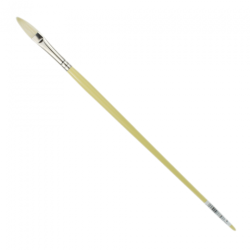
Brushes must have long and fairly soft bristles.
When recognizing a fresco, we use, in addition to optical inspection (seams), a fairly simple chemical analysis - hydrochloric acid test.
As long as on contact with the acid the sample of the painting agitates and hums, we are sure that it is a fresco. Calcium carbonate dissolves in hydrochloric acid with the characteristic release of carbon dioxide.
Glue and tempera do not react to this test.
Samples are taken from dark areas.
The fresco technique is one of the most durable wall techniques, as it allows the plaster to breathe freely. However, it is impermanent outdoors - water dilutes the painting surface, and under the influence of sulfur gases in the air, it partially turns into calcium sulfate (gypsum) and disintegrates.
Indoors, it is rather durable and is only subject to dust.
The durability of the fresco depends largely on the climate.
In dry climates - for example, in Italy - even outdoors old frescoes have survived tolerably well.
The surface of the plaster plays an important role in the durability of the fresco.
It has been found that frescoes made on glossy plaster, specially smoothed (Pompeii), are more durable.
The porosity and roughness of the plaster is bad for its preservation.